AOMusic aligns with causes around the world who are devoted to helping children. We work with SoleHope and HavServe to help crisis ridden areas. But here is one man I want to meet and work with. Scott Nesson. He is someone who can shine a light for all of us on what it means to follow your heart. This is an article from the Christian Science Monitor.

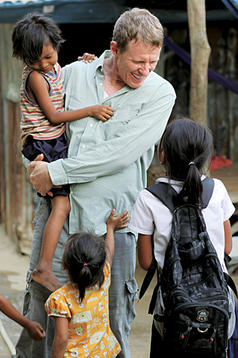
Scott Neeson left Hollywood to save children rooting in Cambodia’s garbage dumps He sold his mansion, Porsche, and yacht and set off for Cambodia to provide food, shelter, and education to destitute children.
Neeson’s final epiphany came one day in June 2004. The high-powered Hollywood executive stood, ankle deep in trash, at the sprawling landfill of Stung Meanchey, a poor shantytown in Cambodia‘s capital
Scott, a former head of 20th Century Fox International, cares for more than 1,000 Cambodian children and their families.
In a haze of toxic fumes and burning waste, swarms ofPhnom Penh‘s most destitute were rooting through refuse, jostling for scraps of recyclables in newly dumped loads of rubbish. They earned 4,000 riel ($1) a day – if they were lucky.
Many of the garbage sorters were young children. Covered in filthy rags, they were scruffy, sickly, and sad.
Clasped to Mr. Neeson’s ear was his cellphone. Calling the movie mogul from a US airport, a Hollywood superstar’s agent was complaining bitterly about inadequate in-flight entertainment on a private jet thatSony Pictures Entertainment, where Neeson was head of overseas theatrical releases, had provided for his client.
Neeson overheard the actor griping in the background. ” ‘My life wasn’t meant to be this difficult.’ Those were his exact words,” Neeson says. “I was standing there in that humid, stinking garbage dump with children sick with typhoid, and this guy was refusing to get on a Gulfstream IV because he couldn’t find a specific item onboard,” he recalls. “If I ever wanted validation I was doing the right thing, this was it.”
Doing the right thing meant turning his back on a successful career in the movie business, with his $1 million salary. Instead, he would dedicate himself full time to a new mission: to save hundreds of the poorest children in one of the world’s poorest countries.
Much to everyone’s surprise, within months the Australian native, who as president of 20th Century Fox International had overseen the global success of block-busters like “Titanic,” “Braveheart,” and “Die Another Day,” quit Hollywood. He sold his mansion inLos Angeles and held a garage sale for “all the useless stuff I owned.” He sold off his Porsche and yacht, too.
His sole focus would now be his charity, the Cambodian Children’s Fund, which he had set up the previous year after coming face to face, while on vacation in Cambodia, with children living at the garbage dump.
“The perks in Hollywood were good – limos, private jets, gorgeous girlfriends, going to the Academy Awards,” says Neeson, an affable man with careworn features and a toothy smile. “But it’s not about what lifestyle I’d enjoy more when I can make life better for hundreds of children.”
He sits at his desk barefoot, Cambodian-style, in white canvas pants and a T-shirt. At times he even sounds like a Buddhist monk. “You’ve got to take the ego out of it,” he says. “One person’s self-indulgence versus the needs of hundreds of children, that’s the moral equation.”
On the walls of his office, next to movie posters signed by Hollywood stars, are before-and-after pictures of Cambodian children. Each pair tells a Cinderella story: A little ragamuffin, standing or squatting in rubbish, transforms in a later shot into a beaming, healthy child in a crisp school uniform.
Neeson has more than 1,300 sets of such pictures; that’s how many children his charity looks after. Every one of the children, the Australian humanitarian stresses, he knows by sight, and most of them by name. “You go through a certain journey with them,” he says. Houy and Heang were among the first who started that journey with him in 2004. Abandoned by their parents, the two sisters, now 17 and 18, lived at the dump in a makeshift tent. “We felt sick and had no shoes. Our feet hurt,” Houy recalls in the fluent English she’s learned. “We’d never seen a foreigner,” Heang adds. “He asked us, ‘Do you want to study?’ ”
Today the sisters are about to graduate from high school. They want to go on to college.
Neeson maintains four residential homes around town for more than 500 other deprived children and is building another. He operates after-school programs and vocational training centers. He’s built day cares and nurseries. His charity provides some 500 children with three meals a day and runs a bakery where disadvantaged youths learn marketable skills while making nutrient-rich pastry for the poorest kids. It pays for well over 1,000 children’s schooling and organizes sightseeing trips and sports days for them. “I drive the staff crazy,” says Neeson, who employs more than 300 locals, many of them former scavengers. “If I come up with a plan, I want to see it implemented within 48 hours. If I see a need, I want to do something about it. You don’t want to see suffering prolonged.”
He sees plenty of both need and suffering.
After decades of genocide and civil war, millions of Cambodians live in abject poverty. Many children are chronically malnourished, and many never even finish primary school. On a late afternoon, as garbage pickers begin to return to their squalid dwellings of plastic sheets, tarpaulins, and plywood, Neeson sets out on his daily “Pied Piper routine.” Navigating a muddy path, pocked with fetid puddles and strewn with trash, which winds among clusters of derelict shacks and mounds of garbage, he picks his way around a squatters’ community. Everywhere he goes, children dash up to him with cries of “Papa! Papa!” They leap into his arms, pull at his shirt, cling to his arms, wrap themselves around his legs. “Hey, champ!” he greets a boy who clambers up on him. “He needs a dentist so badly,” he notes, referring to the boy’s rotten teeth. His charity offers free health care and dental services to the children and their parents.
In 2007 Neeson won the Harvard School of Public Health‘s Q Prize, an award created by music legend Quincy Jones. In June he was named “a hero of philanthropy” by Forbes magazine. (“Well, I finally made it into Forbes,” he quips. “But no ‘World’s Richest’ list for me.”) When Neeson spots certain kids, he hands them their portraits from a sheaf of newly printed photographs he carries around. “I want them to have mementoes of themselves when they grow up and leave all this behind,” he explains. They give him their latest drawings in return.
He stops at a windowless cinder-block shanty inhabited by a mother and her three teenage daughters. The bare walls are adorned with Neeson’s portraits of the girls in school beside their framed Best Student awards.
“I’m so proud of my children,” says Um Somalin, a garment factory worker who earns $2 a day. “Mr. Scott has done wonders for them.” Neeson rescued one girl from being trafficked, another from domestic servitude, and the mother from a rubber plantation, after he had come across the youngest girl living alone at the dump. “We always bring the family back together,” he says. “We help everyone so no one slips through the cracks.” The need is great: Life here can be unforgiving. “This girl has an abusive father. This one here fell into a fire when she was 6. That guy got shot. That one there lost an arm in an accident,” Neeson says, reeling off details.
Then, flashlight in hand, he doubles back down another path – and steps into what seems like a different world. Behind a high-security fence, children sit in neat rows in brightly painted classrooms, learning English and math in evening classes. Others play on computers in an air-conditioned room.
Until recently, the site where Neeson’s new school now stands was a garbage dump. “When I started working for him, I was surprised how much he does for the children,” says Chek Sarath, one of his helpers. “He places their well-being above his own.” Neeson stops by young children who have their eyes glued to a Disney cartoon playing from a DVD. “I miss a lot about Hollywood,” Neeson muses. “I miss Sundays playing paddle tennis on the beach with friends and taking the boat out to the islands.
“Sundays here, I’m down at the garbage dump. But I’m really happy.”
• Learn more about Scott Neeson’s work atwww.cambodianchildrensfund.org.
Visit us at http://www.aomusic.com

 The Gypsy Life